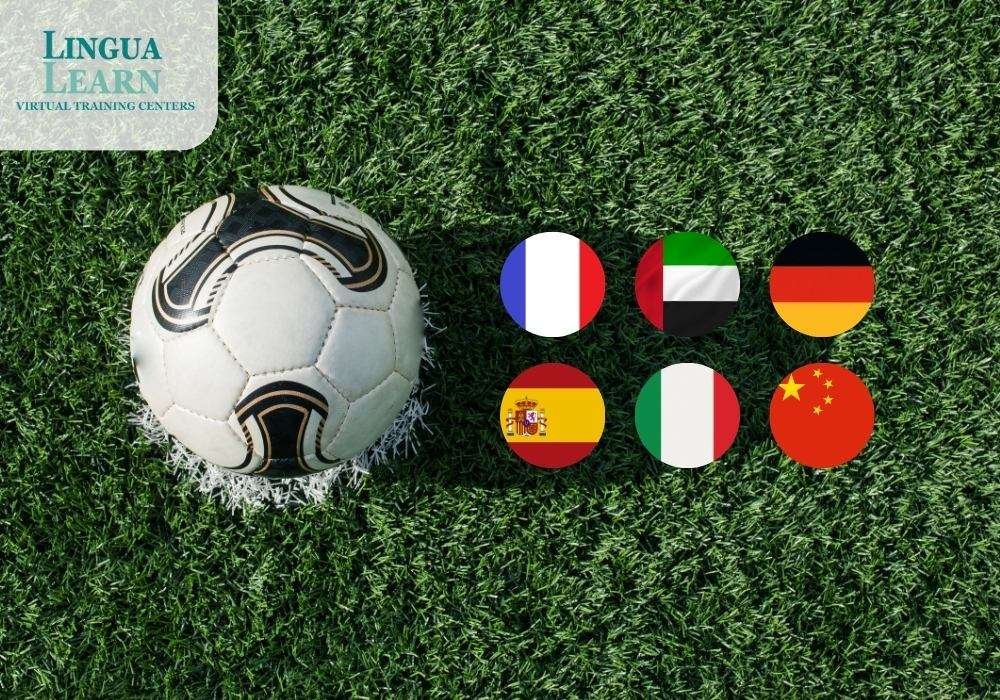
‘Ball’ is one of the first words anyone picks up in a new language, usually because it shows up in kids’ classes, sports, and basic vocabulary drills before almost anything else. It’s also a surprisingly good window into how languages borrow, adapt, or stubbornly keep their own roots.
Here’s the word across six languages, plus the history behind each one.
Kura comes from a Semitic root related to roundness and circularity, the same root behind words for globe and sphere in Arabic. Football specifically is often كرة القدم (kurat al-qadam), literally ‘ball of the foot.’
French actually splits this into two words based on size; ‘balle’ for a small ball (tennis, baseball), ‘ballon’ for a large one (football, basketball, and also literally ‘balloon’). Both trace back to Old French and ultimately Germanic roots, interestingly closer to English than most French vocabulary tends to be.
German keeps it almost identical to English, both languages pulling from the same Germanic root. This is one of those rare vocabulary items where German and English barely diverged at all.
Like French, Spanish distinguishes by size and context; ‘pelota’ for smaller balls, ‘balón’ for larger ones like a football. ‘Pelota’ also names the Basque sport played against a wall, so context matters more than in most translations.
Italian follows the same small/large pattern as French and Spanish, ‘palla’ and ‘pallone,’ all three Romance languages converging on nearly identical logic despite evolving somewhat independently.
Qiú is the general character for ball or sphere, and it combines with other characters to name specific sports; 足球 (zúqiú, foot-ball, meaning soccer), 篮球 (lánqiú, basket-ball). Once you know qiú, most ball-sport vocabulary in Mandarin becomes guessable.
Since this is a word list built for an Armenian audience, it’s worth closing the loop: gndak comes from a root meaning sphere or round object, similar logic to Arabic’s kura. If you’ve been assuming Armenian sits apart from this comparison, it fits the same pattern as everything above.
A single word rarely tells you much about a language on its own, but lined up like this, six ‘balls’ end up tracing surprisingly different histories, some borrowed, some native, most splitting by size the way French, Spanish, and Italian all independently decided to.
If vocabulary comparisons like this are your thing, Lingua Learn’s course catalog covers all six of these languages from true beginner level. Our guide to the easiest languages for English speakers is worth reading next if you’re deciding which one to start with.
 HY
 EN